Showing posts with label drawing.. Show all posts

Monday, June 29, 2020

Urban Sketching

I enjoy sketching, especially when I have a long wait, like at a doctor’s office, jury duty selection (not when the judge is in the room!), or I’m on vacation, at the beach, or at an outdoor concert. It’s fun, and you can use any type of medium, of course, the more portable the better. This type of informal sketching is commonly known as Urban Sketching.


Urban sketching sounds like you would be sketching city landscapes, but it really encompasses more than just high rises and busy streets. Urban sketching is the act of drawing while on location in areas that you live in or are traveling to.

Many artists through the years have practiced some sort of Urban Sketching. Some museums even display sketchbooks, including those by Leonardo DaVinci, Michelangelo, William Turner, John Singer Sargent, and Eugene Delacroix for example.

Sketchbooks often serve a purpose other than for pleasure. Artists would work out ideas for larger works, sometimes doing several sketches of subjects from different angles and with different combinations. Most famous artists carried some sort of sketchbook with them at all times, drawing and making notes. The sketchbook became a type of picture diary.


You can draw in almost any medium. I happen to love using Faber Castell Pitt artist pens, which are like fine-tipped markers and are easy to use, clean and very portable. They come in a huge assortment of colors and are a blast to use.

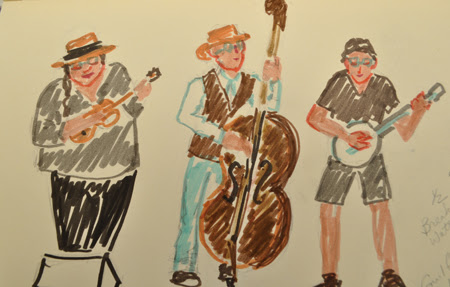
I love to go to the summer free outdoor concerts and draw the musicians and the audience. I draw quickly and keep it simple with only a few details.


I also use micro ink pens for line work. They come in different colors and different size nibs.

You can sketch at your local farmer’s market, museums, beaches, churches, picnics, parks –you name it, you can sketch it! It’s a great way to document the world you live in.


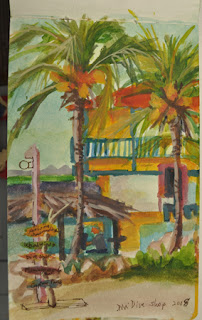
I have a watercolor sketchbook as well. It has a special paper made to absorb liquid. With a small watercolor kit, it’s a great way to do a study or capture a moment in time. And, I just discovered watercolor pencils, which are great fun and are even easier to carry. You can draw the color on the page and then use a water brush to wet the color and blend, just as you would a paint brush. 
   It doesn’t matter how good a sketcher you are. The beauty of urban sketching artwork is the informality of it. You can sketch anything, anywhere, and you don’t need to produce a finished design. You will find that your drawing accuracy will improve with practice, and so will the way that you look at things. 
 

I have several types of sketch pads in a variety of sizes, but mostly I use a soft cover moleskin sketch book, size 5”x 8” for drawing, and a hard cover moleskin, size 5” x 8” made for watercolor. The small size fits into a purse or my carry bag with my box of pens.


A great site that promotes Urban Sketching is Urban Sketchers, “an international nonprofit dedicated to fostering a global community of artists who practice on-location drawing.” The group maintains a network of blogs and online groups where urban sketchers can share their drawings and stories and interact with one another.

Next

I will share some artwork sent to me from several of you. There is some amazing work being done out there.

Class Schedules

There's no update on class schedules. For now, you can view my scheduled classes on my website, though things may change as we get closer to fall.
Stay safe and be well.

Consider Yourself Challenged! 

I know that you have been doing something fun and creative while you sip wine coolers or ice-cold beer during these warm spring days. If you've been drawing, painting, doodling, etching, coloring with crayons, sewing, knitting, embroidering, sculpting, making origami or any other type of creative art, send me a photo. You have one more week to think about it and create something. Send your photos to pmeglio99@gmail.com and I will post them in my next email.  

Tell Me What You'd Like Me to Cover

I hope you enjoyed this session of Urban Sketching. Feel free to share with others.
What would you like to see or hear more about? Which of the instructions did you enjoy the most?
Email me: pmeglio99@gmail.com or just hit reply.

Friday, June 5, 2020

Drawing Simplified - Part I

I've heard time and time again, "I can't draw." or, " I can barely draw a stick figure," or, "I'm not talented enough to be able to draw." I emphatically disagree. It's not a matter of talent. Drawing, like everything else, must be learned. The thing is, more often than not, we've never been trained to draw. Think about it, in school, we were taught our alphabet, arithmetic, and grammar. We've never been taught how to draw, maybe because it was considered frivolous to know how to draw, or perhaps being creative is not considered useful.

These days, with so much going on in our lives and especially with the fear of the pandemic all around us, it's more than ever important to have a creative outlet to turn to. Art can bestow a calming feeling, and help us to cope with life's struggles. Studies have shown that creating art decreases negative emotions, reduces stress and anxiety, and can help you live longer. Creativity helps you see things differently and better deal with uncertainty. Studies show that creative people are better able to live with uncertainty because they can adapt their thinking to allow for the flow of the unknown.

So, where's the best place to start? Some people jump right into a fun medium like painting or pastels, or print making, whether from life or from a photo. However, if you don't have at least basic drawing skills and create a line and value drawing of your subject before you turn to your favorite medium, there's a good chance that you will struggle with the design and structure of your subject.

Like learning your A,B,Cs, or simple math, you need to start with the underlying structure. In most cases, it's worked out in a drawing. The best place to start with drawing is with simple shapes.

What are Simple Shapes?

Everything we see, whether from nature or man-made, can be broken down into simple shapes. These shapes include the square or cube, sphere or circle, and triangle or cone.

Before you protest that you can't draw a straight line, there are tools for that. If you can draw a straight line with a ruler, you can make a square. If you can use a compass, you can make a circle. From a square, you can make a rectangle, and, if you can draw a triangle, you can make a cone shape.
The Square A container like this tea tin, when viewed straight on, is a square.
Extending the lines of your square upward will help you to draw this canister.
           

The Circle

If you have a compass, you can make a circle. When drawing an apple, start with a circle and add the necessary curves and indents that will make up the bottom and the area of the stem.
Add the lip and handle to make this pitcher. While drawing, think about the placement and size of the negative shapes, the areas around the subject.


Use a Guide Line

Draw a straight line up the center of your shape and use it to help guide you as you draw your subject. You can measure from the line to both sides of the circle, square, or triangle to check your shape. This is especially helpful with symmetrical shapes.
The Triangle

Start with a guide line in the center of this conch shell and bottle, then draw your triangle. Curve the short side of the triangle, and you have a cone shape. Do a line drawing, then add shading.
       

Measuring

Whether working from life or from a photo, it's important to check your measurements as you draw. Use your pencil or some kind of measuring device to check both length and width. Check the proportions carefully as you go. When you start with a drawing, it's a lot easier to make adjustments to both the measurements and the composition than it is to make changes in your medium.


One must always draw, draw with the eyes, when one cannot draw with a pencil 
-Balthus

Next

I'll continue with some basic drawing techniques in Part II.

Class Schedules

I'm dying to get back to teaching my classes and I know some of you can't wait to sign up.
I've updated my class schedule for the fall. It's obviously going to depend on whether and when the high schools decide to be open for Adult Ed. classes.
If Artsplace is open, I hope to schedule a class there.
For seniors, it's whether the Town of North Haven deems it safe to reopen the senior center.
For now, you can view my scheduled classes on my website.

While you're there, check out my newest additions to my artwork.

Stay safe and be well.

Tell Me What You're Doing That's Creative

I hope you enjoyed this first session of Drawing Simplified. Feel free to share with others. Please continue to send me photos of your work. I'll do another Creative Challenge in a few weeks.

I'd love to hear from you. Are you feeling inspired? What are you doing to stimulate your creative side?

Friday, April 17, 2020


Remodeling Part 1

Greetings! I hope that you are safe and in good health.

I am like everyone else trying to keep busy, stay productive and remain healthy during this health crisis. All of my classes are on hold and there's no way to tell when they will start again. I know a lot of my students are anxious to get back to class and I do miss my students and teaching.
I am not much of a remote instructor. I enjoy hands on teaching and love the interaction with my students. However, that not being possible right now, I think a lot of you would be interested in how I go about planning and executing a painting.

Most of the time, I start a painting from the beginning with a drawing, canvas prepping, transferring of the design to canvas, and then I spend a few days painting and it's done. Sometimes, though, I revisit a painting that started out okay, but then suddenly stopped dead in its tracks. Usually, I am not happy with the direction it's going and rather then go raging mad and rip the canvas apart like Cezanne often did (though I admit occasionally the thought does occur to me!), I set the painting aside and look at it now and then. I think about how I can modify and improve it. I call it "Remodeling," though I don't use a sledge hammer.

By the way, if you haven't seen the Netflix movie, Cezanne et moi, about the friendship of Paul Cezanne and Emile Zola, I highly recommend it! You can find it on Netflix.

But I digress. I started this painting about three years ago, and was unsatisfied with some parts of it, so I have been pondering over it ever since. I'm now ready to tackle it with a fresh new perspective. I thought that some of you might be interested in how I rework a painting, so I'm going to post the original artwork for this first post, and I'm going to show you how I'm planning to change it. I will send out additional emails that will show the steps that I take and will tell you the reasons for my steps.

Here it is:


The Drawing

The first step is to start with a brand-new drawing. I had some drawing paper that was the exact size of the canvas, which helped. I began working on a new design using a soft pencil and a kneaded eraser. I decided that I liked the mandolin and tambourine, so they will continue to be part of the setup. I liked the colorful fabric because it gave an interesting texture to the design but I didn't care for the white fabric and felt the small objects were lost in the design, so I discarded these. I re-positioned the tambourine and added the guitar, sheet music, and pen. The background will be very dark except toward the bottom where the fabric will be reintroduced.

It's important to note that my drawing is not just a line drawing, but also includes the dark and light areas (values) which I believe are critical to the design. If there's a nice balance of contrast, the picture will be more pleasing. This design shows a good mix of light, medium and dark values. The position of the items is also important. The eye should always be "invited" into the picture like a welcome guest and "asked to stay."


In a few days, I'll post the next step in the process. So sit back and relax. I hope you enjoy this free instruction. Perhaps it will inspire you to pick up that brush and paint a masterpiece!

Tip: Measure as you go, check accuracy by turning the canvas upside down and/or use a mirror.

Another Kind of Remodeling

Finally, I managed to get past some of the problems that prevented me from rebuilding my website. I'm happy to say that the new site is up and running. You can now view it from a computer or mobile device. I have a new Art Instruction page and a new Contact page. The dates for instruction and exhibitions are not current since I designed it before the pandemic shut things down, but I will update it when I have good dates.

I'm hoping that classes resume in late spring, but if they don't, I will be offering the same classes in painting and drawing this fall at Hamden Adult Ed, and Wallingford Adult Ed. I hope to offer classes this summer at Artsplace and continue with painting classes at the North Haven Senior Center. Stay tuned for updates.


There’s no such thing as talent. Good art takes a lot of work, a lot of hours, and a lot of patience. A good artist has earned his way.