Showing posts with label country landscape. Show all posts

Monday, June 22, 2020

Color and Reflected Light

COLOR, it’s everywhere and as long as we can see, we all experience it from the moment we open our eyes. They say that the human eye can detect around ten million hues. When we paint, we all strive to capture a small percentage of it, and often get frustrated in the process. We squeeze out luscious piles of color onto our palette in anticipation of capturing the beauty of a subject with it. Sometimes, we hit the colors on the mark. Other times, we get frustrated as we struggle through a painting when no matter what we do, we can’t seem to find the right mix. And, to make things worse, it’s not just local color, but also reflected color and the temperature of the light that we need to take into account when deciding on a shade. 

Color Choices

So, what is it about color and our color preferences that excite us? Color evokes strong emotional responses in all of us, but not necessarily the same types of responses. Blue may mean calmness and relaxation with visions of the ocean or a beautiful lake to one person, while denoting sadness to another. Depending on our life experiences, our preference for color can be psychological. For example, white might mean pleasantly clean and sterile to some who feel comfortable with a clean antiseptic environment, but cold and icy like a chilly winter day to others. Cultural traditions also influence our preference to color. If you look at color in clothing, for example, you may find that some of the cultures closest to the equator where weather is warmest tend to wear very strong, bright colors, while those in much colder climates tend to wear more subdued neutral colors.

Local and Relative Color

light creates the local color or colors of an object because each object possesses certain chemical properties or qualities that absorb some rays and reflect others How much an object absorbs and reflects determines the color of an object. However, we cannot go by local color alone. As artists, we need to put away our preconceptions about color and look at the relativity of color, i.e., the relationship of color to its surroundings. Changes to color happen when the light source changes, for example, when a sunny day (warm light) turns into a cloudy one (cool light), or when other colors that surround a subject change.

The Influence of Surrounding Colors

A subject’s colors are directly influenced by the color of objects that surround it. This color is possible because of reflected light. Reflected light helps to model form and gives variety to our shadows. A white building may take on the color of the bushes below and around it, because the light from the sky will bounce off of these objects and project on the surrounding objects.

The color of the Wadsworth Mansion in this painting was not pure white, though I’m pretty sure that if you asked the workers who painted the building what color they used, it would be some variation of white, such as titanium. The day that I painted it, the trees and flowering bushes around it projected a warm orange glow upward that originated from the sunlight that was in front of me, slightly to the left and somewhat high in the sky. There was very little direct light on the front of the building.

Reflections and Adjacent Objects

In the still life, the warm yellow of the lemon was reflected onto the cool bluish white surface, and the red skin of the apple and the peel of the orange reflect onto the normally white dish near the fruit as well as onto the fruit adjacent to them. 

Color Relationships

The six color squares are a good demonstration of the influence of surrounding colors. The orange color in the center is exactly the same for all six squares, yet depending on the color that surrounds the orange, the orange square appears to be a different shade. Note also that the stronger the color that surrounds the orange, the more it influences the perception of the orange hue. 
This is one example of how color values can draw attention to an object or provide a more subtle color shift. One color can become darker, lighter, warmer or cooler in relation to another color. When painting, try to relate and compare all of the colors in your composition to one another. Ask yourself, Is one color lighter or darker than the other? Is one color warmer or cooler than the other?


Next

I’m going to share my moleskin and small sketchbook sketches of people and places that I do for fun and practice. I'll talk about the types of media that I use when doing quick sketches.

Friday, May 29, 2020

Painting the Farm River - Part III

Welcome back to Painting on the Farm River. This is the final installment of this series. I hope I have inspired you to go out and paint from life nature in its beauty among the birds, butterflies, and nefarious bugs. If you've never tried it, it seems daunting, but be brave! You will learn so much by working from life, I promise.
Last week, I threw the gauntlet down, and challenged you. The response has been lukewarm and my armor is getting heavy. It would be fun for everyone to see your artistic inspirations, so you have one more week to share.

Aerial Perspective

The view from where I stood included a tree line at the farthest point of the river that stretched two to three miles. To understand how to paint objects in the distance, it is important to understand how Aerial Perspective works. Aerial Perspective is the atmospheric distance between objects in a painting. The presence in the atmosphere of moisture and tiny particles of dust and similar material causes a scattering of light as it passes through them, the degree of scattering being dependent on the wave length which corresponds to the color of the light.

Because light of short wavelength (blue light) is scattered the most, the colors of all distant dark objects tend toward blue. For example, distant mountains have a bluish cast, and yellow disappears as it recedes, followed by red.

The heavier the atmosphere, the more pronounced the effect. It is most apparent in lower elevations that commonly have higher amounts of moisture in the air. There are value changes as well. All things become cooler in color (except white) and lighter as they recede into the distance, and their edges soften. White takes on a warmer and darker shade.


"It would be impossible for me to paint slowly out of doors, even if I wanted to... There is nothing immobile in our surroundings. Water curls up all the time, clouds change shape as they change places; the rope that hangs from that boat over there swings slowly back and forth; the boy jumps; those trees bend their branches and raise them up again...But even if everything were petrified and fixed, it would be enough just for the sun to move, as it does continuously, in order to give a different appearance to things... One must paint quickly, because so much is lost, in an instant, and you never find it again!"

–Joaquin Sorolla, speaking of his time spent painting in Javea

From My View


Three hours had passed by since I began painting en plein air and the painting was starting to take shape. I’m more than ever aware of values and edges as I mixed and applied my paint.
The bushes and trees in the distance were lighter in color, and value, so I lightened them with white (a cool color) and used less yellow in the mix. The vines and trunks became a lighter red/purple. I also softened the edges quite a bit to push them into the distance.
The sky was a nice light blue, with no clouds. The sun was in front of me, overhead but not within sight. It provided some beautiful reflections on the water.
Since I began, the sun had moved and the light was beginning to change, so I stopped. When painting outdoors on a sunny day, you only have between two and three hours before the light changes, affecting the values of the subject and the length and direction of the shadows. Cloudy days are more forgiving.

I finished the painting in my studio, with the memory of the river still fresh. The blue in the water needed more emphasis, as did the moss greens, the rocks, and the lightest highlights on the water, rocks and the hemlock tree. I also darkened my shadows under the fallen trees and near the rocks. I had a photo, but only referred to it for detail information.

Next

Some photos of your artistic endeavors.

"Painting, when you feel it, is the greatest thing in the world. No, I've said it wrong, it's Nature that is beautiful."
-Joaquin Sorolla

Consider Yourself Challenged!

I can’t believe that only two of you have been working on art since the advent of this pandemic. At least, I’ve only heard from two since I’ve started this email lesson. I know there are more of you being creative during this time of seclusion, so step up to the challenge!

Hey, this armor is getting pretty uncomfortable so give me a break. If you've been drawing, painting, doodling, etching, coloring with crayons, sewing, knitting, embroidering, sculpting, making origami or any other type of creative art, send me a photo. 

Wednesday, September 6, 2017

Sunflower Painting

I was painting recently in North Branford in the middle of a beautiful acre of sunflowers when a wonderful photographer asked if he could take my picture. I said yes, then thought to ask him to email me a copy. Here it is. The photographer is Dennis Beaulieu. I love the photo, thanks, Dennis! Here are the two paintings that I did there, each on different days.
 They are both oil on canvas over panel, 9"x12".
The sunflowers were simply gorgeous this year, and the fields stopped traffic for quite a long time.
Sunflowers are fun to paint. The rich oranges and yellows really stand out against the cool green leaves and blue sky.


Friday, February 10, 2012

Don Demers Workshop in Falmouth, Mass.

I signed up for a workshop given by Don Demers, who is a professional landscape/seascape painter from New England. It's going to be at the Falmouth Artist Guild, in Falmouth, Mass. for three days in September. I'm really looking forward to this. Falmouth is in Cape Cod, and the workshop is the weekend after Labor Day. The summer crowds should be gone, but the weather should still be really nice. I'm hoping to pick up some great pointers about plein air painting. I share his appreciation for the painterly style of painting. His seascapes are amazing. He really knows how to paint waves. I signed up early for this, since his workshops sell out quickly. I may buy one of his DVDs from his Website.

Monday, January 16, 2012

Hockey Game


I set out to paint at a favorite spot hoping to catch a good snow scene. There's a really nice pond near where I live and I thought that the icy surface and the snow scenery around it would make a good picture. When I arrived, several young teenage boys were clearing the ice and getting ready for a fun neighborhood hockey game. I decided to set up and paint them. They were very nice about it and were quite curious about what I was doing. How lucky I was to have such a interesting diversion from my normal everyday landscapes. The players' clothes added a punch of bright warm color to the blues and purples of the winter snow. I am finding that I enjoy adding people to some of my paintings. I feel like they add life and enhance the surroundings.

Wednesday, July 20, 2011

Abandoned House

I started this painting a couple of years ago and put it aside. I just didn't like it. A couple of months ago, I worked on it some more and I like it a little bit more now. The house is owned by a farmer who lives next door. It is getting pretty old and sad looking, but it has some nice features like the side bay windows. I can imagine a large farming family living in it and growing corn and other crops and raising black and white milk cows in the surrounding fields back in the early 1900s. I hope that some day someone will tackle its remodel and restore it to its glory once more.

Friday, August 6, 2010

Open Doors of Downtown Milford Art Exhibit

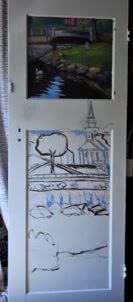
This is the door that I will be entering in the Open Doors of Downtown Milford Art Exhibit. I started my design and study in May by doing small studies of places in Milford that I enjoy and find interesting. Once I decided on the scenes that I wanted to use for the door, I chose a base color for the door, painted it, and started drawing my scenes using charcoal directly on the door. I decided to combine two themes that are prevalent in Milford.

One is the river that flows through the city to the ocean, along which a pastoral pond and park have been the site for numerous visits by residents. For many years, wedding photos were taken at the falls with its gorgeous pastoral view, and parents and their children come by to feed the ducks and geese.

The other theme is the sea, with the Milford Marina filled with all types of boats, and the sailboats out in the open sea on the bottom panel, and the popular Silver Sands Beach with Charles Island in the distance on the top panel.

I attached sound cards on each side, with recordings of geese and ducks quacking for Tranquil Waters and ocean waves and seagulls singing for Sea Breezes.

Please come by and visit me on August 20th. I will be there with my door and some additional paintings of Milford for sale. The auction in September is an exciting event as well. There will be food and refreshments and a lively crowd.

The finished door.

The falls in progress and then finished.

Closeups of each panel.

Tuesday, July 14, 2009

Carriage Stone Farm


This is a horse stable up the street from my house. It has gotten larger over the years. The view is from high up on a hill overlooking the farm. Our area is surrounded by hills in a pretty country setting. I attracted an audience of young children as I painted this on site. They were very quiet and captivated by my work.

Carriage Stone Farm
Oil on canvas, 18" x 28", $550

Friday, October 17, 2008

Emil's Bench


Recently, I made a weekend trip to Maine with two friends to visit Marge, another friend, and her husband. We stayed at Marge’s sister-in-law’s house for the weekend while she and her husband were away on a month-long meander through France (How lucky for them!). The house is a four-year-old, upscale two-level colonial, with tenderly cared for gardens and flowing paths, that backs up to Penobscot Bay on the east. The view from the back of the house, which is lined with large picture windows overlooking the bay, was breathtaking, especially in the morning when the sun slowly shows its face above the horizon. Marge drove us early the first day to a few local sights where she thought that I might find some good places to paint. One place was a campground, with a long winding road to a very high vantage point that overlooked Camden Harbor. Later that day, my friends and I went back there and I set up my easel. I painted the busy harbor with its many boats and the view of the bay while my friends read their books and relaxed. The fall colors were just starting to infuse the scenery, so the painting is splashed with shades of red, yellow, orange, and green and lined from above with the sea-blue ocean and bay. With the crisp fall air, it was a wonderful day to paint.


While up in Maine, Marge asked if I could paint a painting of a hand-hewn wood bench that her husband Emil’s father made many years ago. It is now in his sister’s possession sitting amongst the flowers, trees, and young bushes in her side garden. With my camera, I took several photos of the bench from different angles. One photo included a red wooden bird house, which I thought looked great with the bench. I used this photo as a reference and created a cozy, mini painting of the scene. The leaves were starting to change colors, so there were some light oranges and yellows, plus a strong beam of light on the bench that became the focus of the composition.

Emil's Bench, Oil on canvas over board, 6"x8"

Friday, January 18, 2008

Scenes from New England

cabin,country,impressionist,rustic

I love to paint scenery in my native countryside. I am lucky to have friends who have homes in Cape Cod, Old Saybrook, Ct, New York State, and in the Boston area who have offered their homes as weekend retreats so that I could set up and paint.

This painting of a friend's cabin in upstate New York is an example of my attempts at plein air painting.