Showing posts with label tour. Show all posts

Friday, November 19, 2010

Part V: The Tour of the Boston Public Library

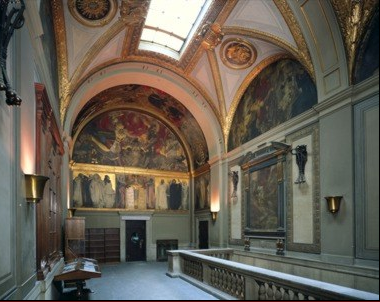
The last installment of the Boston Public Library Tour series is the main reason that I wanted to tour this library in the first place. One of the largest and most controversial murals of all time is known as the Sargent Gallery. This 84 foot long, 23 foot wide, and 26 foot high space is actually a hallway between the Chavannes Gallery and Bates Hall. The atmosphere in this gallery is rather somber as is the subject matter, which is the progress of religion from pagan worship to modern individual freedom and spirituality. Named the Triumph of Religion, Sargent worked for years on the murals that depict Christian and Jewish religious scenes from the Bible and other writings. The figures depict the influence of pagan gods on mankind, and religious law, redemption, and guidance. Figures of the Messiah, Madonna, the blessed Trinity, and angels are painted in storybook style illustration in large murals high on the walls.

Sargent began the Triumph of Religion mural project in 1890 in Gloucestershire, England, and later, when he moved to London, he constructed a one-third-scale of the Library’s Special Collections Hall. Some of that construction still exists today. He made hundreds of preparatory studies in graphite, charcoal, and oil and sometimes added text to his murals from religious writings. He traveled extensively abroad for inspiration, visiting museums, and making sketches of historical monuments abroad. He copied Byzantine style painting, Egyptian and Greek art and hieroglyphics, medieval sculpture and European architecture.

Sargent used plaster and gold inlays for the first time on some of his murals to give them a three dimensional appearance. A crucifix is the most sculptural of all the pieces in the Hall, with the arms and heads of the figures rising outward completely from the wall.


The Synagogue panel was the subject of much controversy when it was displayed. Both Jewish and Christian individuals and groups urged its removal.


The Massachusetts state legislature passed—and then repealed—a bill to remove the picture. In 1924, two months before the repeal of the legislature’s bill, an unidentified individual splattered Sargent’s Synagogue with ink. Sargent and Herbert Thompson from the Museum of Fine Arts, Boston, headed the restoration and were able to repair the damage done. Though it is unknown why, the controversy appears to have been the main reason that he abandoned Triumph of Religion before painting the planned keynote image, Sermon on the Mount. There remains one lone panel that is empty.


Another reason might be that after WWI, the artist’s metaphorical use of Jewish and Christian history and scripture to signal the progress of Western civilization from a pagan, dogmatic, and institutional past toward individual freedom and spiritual subjectivity became a less compelling subject.


The Triumph of Religion was completed in 1919.

Photos courtesy of the Boston Public Library.

Friday, October 29, 2010

Part 2: Tour of the Boston Public Library Central Branch


The original site of the Boston Public Library was where the Colonial Theatre is today. The current site was built on what was once a swamp in Back Bay. Back Bay was filled in with hundreds of wood pilings before anything could be built on it. Many of the surrounding buildings are also structured above wood pilings sunk deep in the mud, and the water was extracted.

Inside the McKim building, the vestibule harbors a statue of Sir Henry Vale, Governor of Massachusetts Bay Colony in 1636-7. Three large bronze doors with sculpture reliefs designed by Henry French grace the entry way.

Iowa sandstone piers line three aisles of the entrance hall, which is a feast for the eyes. A vaulted ceiling displays thirty names of famous Bostonians, including writers, politicians, and community leaders, in marble mosaic. A seal on the floor of the lobby denotes the founders of the library, and signs of the zodiac in brass are inlaid in the center aisle. Everywhere there is marble and sandstone, in pale earth colors that are illuminated by mostly natural light from large windows from the second floor landing.

Connecting the Entrance Hall with the Main Staircase is a deep triumphal arch. The marble of the very polished steps is ivory gray Echaillon, mottled with fossil shells and the walls are a richly variegated yellow Siena marble.

The great twin lions, couchant, on pedestals at the turn of the stairs designed by Louis St. Gaudens are made of unpolished Siena marble. They are memorials to the Second and the Twentieth infantry regiments of the Massachusetts Civil War. My next installment will describe the paintings by Puvis de Chavannes at the top of the stairs.

Wednesday, October 27, 2010

Part I, Tour of Boston Public Library


I recently participated in a tour of the McKim building in the central branch of The Boston Public Library. The Boston Public Library Central Library is located in Copley Square, a major hub of activity in the city of Boston. Established in 1848, it was designed to be a free library for the people, which was unheard of at the time. It was the first publicly supported municipal library in America, the first to lend books, the first to have a branch library, and the first to have a children’s room.

There are two buildings in the central library, the McKim and the Johnson buildings. Designed by McKim, Mead, and White, the oldest building known as the McKim building, is a huge mass of granite and marble with carvings and embellishments on the exterior and interior spaces that make it a work of art unparalleled today. McKim hired mostly American artists to create murals and sculptures that decorate the many rooms and lobby areas of the library, and the entrances. Minerva, the goddess of wisdom, graces the central keystone over the main entrance directly over the seals of the Commonwealth of Mass, the Library, and the City of Boston. The façade is decorated with the names of the great masters of art, science, religion, and statesmanship, and two large statues that represent Art and Science flank the steps leading to the entrance.

The Johnson building is the modern part of the central library and is only briefly described in the tour. Its architecture is not as impressive as the McKim building, though it does have modern amenities.

My next post will describe the interior architecture of the McKim building, which is very impressive.