Showing posts with label Sargent. Show all posts

Friday, November 19, 2010

Part V: The Tour of the Boston Public Library

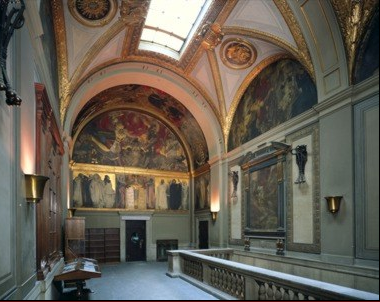
The last installment of the Boston Public Library Tour series is the main reason that I wanted to tour this library in the first place. One of the largest and most controversial murals of all time is known as the Sargent Gallery. This 84 foot long, 23 foot wide, and 26 foot high space is actually a hallway between the Chavannes Gallery and Bates Hall. The atmosphere in this gallery is rather somber as is the subject matter, which is the progress of religion from pagan worship to modern individual freedom and spirituality. Named the Triumph of Religion, Sargent worked for years on the murals that depict Christian and Jewish religious scenes from the Bible and other writings. The figures depict the influence of pagan gods on mankind, and religious law, redemption, and guidance. Figures of the Messiah, Madonna, the blessed Trinity, and angels are painted in storybook style illustration in large murals high on the walls.

Sargent began the Triumph of Religion mural project in 1890 in Gloucestershire, England, and later, when he moved to London, he constructed a one-third-scale of the Library’s Special Collections Hall. Some of that construction still exists today. He made hundreds of preparatory studies in graphite, charcoal, and oil and sometimes added text to his murals from religious writings. He traveled extensively abroad for inspiration, visiting museums, and making sketches of historical monuments abroad. He copied Byzantine style painting, Egyptian and Greek art and hieroglyphics, medieval sculpture and European architecture.

Sargent used plaster and gold inlays for the first time on some of his murals to give them a three dimensional appearance. A crucifix is the most sculptural of all the pieces in the Hall, with the arms and heads of the figures rising outward completely from the wall.


The Synagogue panel was the subject of much controversy when it was displayed. Both Jewish and Christian individuals and groups urged its removal.


The Massachusetts state legislature passed—and then repealed—a bill to remove the picture. In 1924, two months before the repeal of the legislature’s bill, an unidentified individual splattered Sargent’s Synagogue with ink. Sargent and Herbert Thompson from the Museum of Fine Arts, Boston, headed the restoration and were able to repair the damage done. Though it is unknown why, the controversy appears to have been the main reason that he abandoned Triumph of Religion before painting the planned keynote image, Sermon on the Mount. There remains one lone panel that is empty.


Another reason might be that after WWI, the artist’s metaphorical use of Jewish and Christian history and scripture to signal the progress of Western civilization from a pagan, dogmatic, and institutional past toward individual freedom and spiritual subjectivity became a less compelling subject.


The Triumph of Religion was completed in 1919.

Photos courtesy of the Boston Public Library.

Monday, October 4, 2010

Visit to the Sterling and Francine Clark Art Institute

I visited the Sterling and Francine Clark Art Institute  over the weekend and was very impressed with their collection of American and European art from the 18th, 19th, and 20th centuries. There were fantastic paintings by Monet, Remington, Pissaro, Sergent, and Homer. What I really fell in love with was the Giovanni Boldini (1842-1931) collection. The Clark has the largest collection of Boldini paintings in America. His paintings at the Clark were mostly small, but done with an impressionist style that was intricate, colorful, painterly, and vibrant. He painted landscape and street life in Paris where he lived and was famous for his portraits as well.


Portrait of Mrs. Howard Johnston by Giovanni Boldini.
Sterling Clark settled in Paris and began collecting works of art, an interest he inherited from his parents. When he married Francine Clary in 1919, she joined him in what quickly became a shared passion. Together they created a remarkable collection of paintings, silver, sculpture, porcelain, drawings, and prints with complete reliance on their own judgments and tastes. In 1950 the Clarks founded the Sterling and Francine Clark Art Institute as a permanent home for their collection, and the museum first opened to the public in 1955. Since its conception, the Institute has had a dual mission as both a museum and a center for research and higher education. It is in this spirit that the Clark has expanded over the last five decades to become the influential institution it is today.

A variety of special exhibitions is offered throughout the year, bringing together works from collections around the world and presenting them in intelligent, enlightening, and visually appealing installations. Recent exhibitions have included Dove/O'Keefe: Circles of Influence; Toulouse-Lautrec and Paris; Like Breath on Glass: Whistler, Inness, and the Art of Painting Softly; The Unknown Monet: Pastels and Drawings; Gainsborough, Constable, and Turner: The Manton Collection; Consuming Passion: Fragonard's Allegories of Love; and Remington Looking West.

The current exhibit is of John Constable, including works by his son, Lional. Coming in November, Albreckt Durer, the German Renaissance painter and printmaker. I highly recommend that you see this collection and their regular collection.

Picture courtesy of Artrenewal.com.