Tuesday, May 4, 2010

Artist Workshop at North River Arts Society

I took at workshop with Stapleton Kearns in Marshfield Hills, Mass last weekend at the North River Arts Society. The area was an old New England town with original houses from the 17th and 18th centuries. It is very close to the ocean with lots of salt marshes and wonderful views of islands off of the mainland.

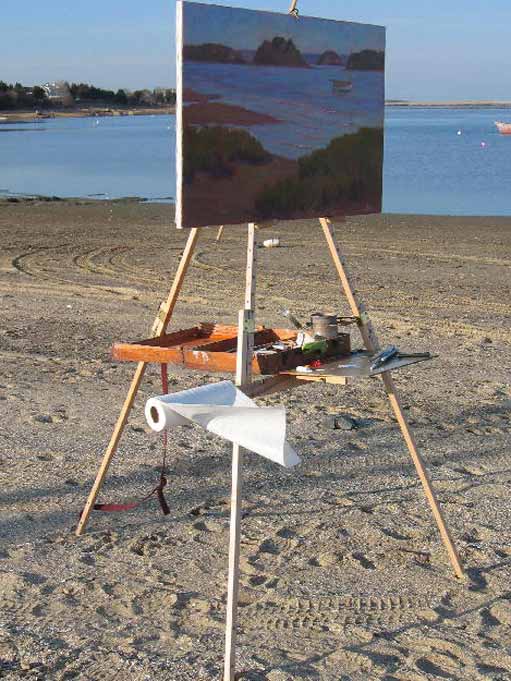
The first day, we headed to the beach just south of Scituate. It was a test of wills with the wind, and somehow I managed to keep my easel upright, though I did have problems with the painting from the start. I was amazed at the stability Stape's Gloucester easel  in the 59 mph wind. It didn't move at all. His setup looked stable and seemed light to carry. The Take-it-easel is a similar design.

The next day, we headed over to some salt marshes, as tried to quickly capture the view before the water drained down at low tide. The scenery was gorgeous, and you could see for miles across the water and marshes to an island in the distance.

Stape gave me some good pointers in design. He said to divide up the space into three spaces, Papa Bear, Moma Bear, and Baby Bear. Make one area the largest and most important, another secondary, and another, the smallest. Also, he warned against leading the eye off or too close to the edge. Think first of design, where the eye leads within the picture. He also tried over and over to get us to hold our brushes at the ends, with thumb pointed up for upward or side motions. For downward motions, hold at the end and pull down. But, pull and push the brush for light, easy strokes that don't destroy the work underneath.

For my sky, he had me take some very light peach and pull across in small patches to illuminate the sky and give it life. This is over the blue and white areas. In one painting in the beginning, he also took light peach and used it on the horizon line in a large swath, then mingled in blue and white at the top edges of this. He seems to have a lot of sky in his landscapes, but he never cuts the picture in half. To get the horizon line correct, he uses a stick or a brush to measure down from the top of the canvas.

I seem to make my distant land a bit too dark. Stape corrected this for me. I have to watch out for this. Also, put a line of lighter blue across the water near the horizon line to give the water some glimmer. Add darker tones for water ripples here and there, to counteract flatness.

The last day was spent at World's End, a nice island set in Nantasket. It was a wonderful day there, though the hike to the painting spot was hard work. I will definitely have to replace my glass palette with plexiglass or wood for large treks. We had a nice breeze off of the water that helped to displace the hot air.

The group was fun, and because it was small, we had great input from Stape and lots of attention. He liked to ask us what we learned, after each visit and day. It kept us thinking.

I think that the hardest thing when learning how to paint is to remember everything while you are out there. It has to become intuitive. I think that it takes years to develop this skill.

Friday, February 26, 2010

Tilcon Rock Crusher

Last year, I went on a tour of the Tilcon facility in Northford and got an eye opener view of what has been one of the town’s largest industries for many years. Tilcon Connecticut Inc. is a leading supplier of crushed stone, hot mix asphalt, and ready mix concrete in Connecticut.


Giant rock slicers pierce big slabs of rock in the nearby quarry. Using monster front loaders, workers load the rock into huge dump trucks. The dump trucks deposit their loads into the rock crushers at the top and collect it at the bottom. I have long wanted to paint this enormous rock crusher, one of two in this location. It is a huge iron green machine, able to crush very large blocks of rock into various sizes of stone, depending on the order. Workers are able to enter and climb the rock crusher through a system of doors and stairways.

I was unable to get access to paint en plein air, so I was restricted to photos that I took from the bus and from across the street. I made up a couple of drawings before I started to paint just to get a feeling for the composition. I tinted the background with a mix of thalo green, ultra marine blue, and transparent oxide brown. I began by blocking in shapes starting with the darks. The overcast sky and serenity of the scene belied the powerful force of the rock crushing jaws, and heightened the strength of the greens and shadows of the structure. The American flag, the only spot of bright color, is a tribute to patriotism probably put there just after 9/11.

Painting: Rock Crusher, 12x20, Oil on Canvas, $350.

Wednesday, January 13, 2010

Rembrandt Exhibit at Wadsworth Antheneum

I went to see the Rembrandt exhibit at least three times at the Wadsworth Antheneum in Hartford. It is small but really special. As you might expect, you get so much more out of viewing a painting in person as opposed to looking at books or other reproductions.  The brightness and livliness of the colors is incomparable. And, even more important, you get to see the brush strokes, which are quite deliberate and facinating. His self portraits are my favorites, the colors and design really stand out and demonstrate his brilliance. I bought the museum book on Rembrandt, which has wonderful photos of many of his works and details his life and experience as an artist.  The museum also played an old movie of Rembrandt, starring Charles Laughton. The film takes you to 1642 at the height of Rembrandt's career and follows his life until his last year. It was pretty old and quite amateurish by today's standards, but the details were not that far off from official accounts of his life. What an interesting man he must have been.


This exhibit is going on through January 24, 2010. If you have a chance, go and see it.

Tuesday, December 22, 2009

Bocce


I spent some time visiting an all male Italian club in Kensington, Ct over the summer. The club house has six full scale bocce courts in the back, complete with regulation clay surfaces and divided and marked lanes. The guys get together most evenings and even on the weekend, and play. They hold tournaments on certain nights during the summer, with a mix of men and women on Monday nights, a serious group of men who play on Tuesday nights, and a more casual group of men who play and mingle on Wednesday nights. The men are a mix of old Italian-speaking-only men to young Americanized men who have one thing in common: they all enjoy a good game of bocce.

There is a bar adjacent to the courts where they can get a cold alchoholic or soft drink, and a large outdoor grill is always ready to grill the hotdogs or hamburger meat that they keep on hand and cook as they please.

When I watch them, it takes me back to when, as a child, I watched my grandfather and father and uncles and their male friends gather in our back yard to throw some balls. My grandfather had a monogrammed set, made of granite or marble, in various natural stone colors, so unlike the commercial sets that you see in the stores. I decided to paint the scene of the men playing bocce, taking into account their concentration and attention to the details of the game. I'm hoping to do a series next year.

Thursday, December 10, 2009

Things That I Remind Myself When Painting

It often seems so simple when an instructor shows me how to improve my work. They make it look so easy. What's worse is that I tell myself, "I know that, why didn't I do that?" I think that some of these things are not yet intuitive, or maybe they just are not yet ingrained in my memory. Perhaps after a few years, they will just pop to the surface.


I am starting, very, very slowly to see things that need improvement in my and other artists' painting. Still, I know that I don't always see things the way the experts see them.

Some items that I need to remind myself when painting:

  • When composing a painting, design a direction that will lead the eye into the painting and keep it there.
  • Soften edges to allow items to fade into the distance or to become less important.
  • Sharpen a few edges to pull the eye to the desired areas.
  • Use highlights sparingly.
  • Distribuite colors around the canvas rather than containing them to one area. This unifies the design.
  • Bring in background color for shadows and to help to add dimension to items.
  • Watch for curved items and remember to blend dark to light to establish three dimensions.
  • When painting leaves, use a large brush and add the color in one big swipe. Later go back and add details but keep it simple.
  • When painting reflections, especially in water, the reflected image is slightly lighter and less defined than the image being reflected.

Saturday, November 28, 2009

Club Auction Painting


The Northford Women's Club held their annual Holiday Auction in November. I donated this painting of a china cup and saucer. My friend, Michelle, bid the highest and she now owns this little gem.

The auction raised more than ever before, and was a lot of fun.

"I'll Have Coffee" - Oil on canvas over panel, 6"x8"

Sunday, November 8, 2009

Raffle Winner


This teapot painting was raffled at the 47th on the Green show in Glastonbury. It is a 6"x8" original oil painting, on canvas over panel. The winner is Nancy Cretaro of Manchester, CT. Congratulations, Nancy!