Showing posts with label colors. Show all posts

Wednesday, December 8, 2021

The Paintbox: Ultramarine Blue

In London’s National Gallery is an unfinished oil on wood panel, The Entombment, by Michelangelo. Many of the unfinished parts of the painting, such as the cloak of the missing Virgin, would have required quantities of the expensive blue pigment ultramarine made from powdered lapis lazuli, the only blue worthy of the Virgin Mary’s robe.

It’s possible that lapis lazuli was in short supply and had not arrived from his patron, which could explain why the painting was not completed before Michelangelo’s departure from Rome to Florence in 1501.

Definition and Composition

Cennino Cennini said of ultramarine in his Book of Arts in 1400, “A noble color, beautiful, the most perfect of all colors.”
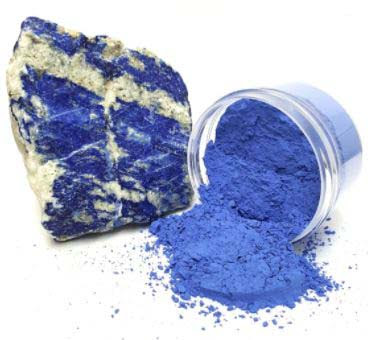
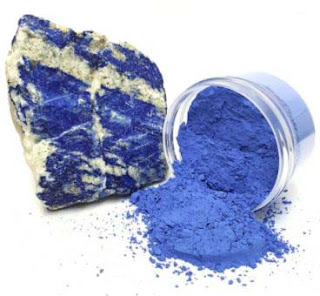
Ultramarine is a deep blue pigment, originally made by grinding lapis lazuli into a powder. The name is Latin for ultramrinus, meaning “beyond the sea.”

Lapis lazuli is a mixture of the minerals calcite, sodalite, pyrite, and lazurite. Finer grades contain more sulphur, which produces a violet color, while inferior grades contain more calcium carbonate, giving it a grayish tone. The impurities are removed in the processing to produce the pigment. 

History 

 Between the eleventh and eighteenth centuries, the main west-east axis, the Silk Road, brought Asian materials, including silk, inventions and art to Europe. The Silk Road consisted of land routes connecting East Asia and Southeast Asia with South Asia, Persia, the Arabian Peninsula, East Africa and Southern Europe. Mediterranean trade between the Middle East and North Africa and Europe in the twelfth through fourteenth centuries was conducted largely by Italian and Greek maritime republics.
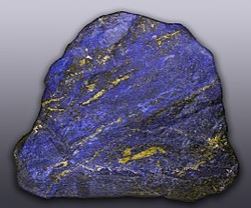

During this period, Italian traders introduced lapis lazuli to Europe from Afghanistan, most notably, from ancient mines in Sar-e-sang, the “Place of the Stone,” a settlement in the Kuran Wa Munjan District of Badakhshan Province. Today, it can be found in other locations including Asia, America, Chile, Zambia, and Siberia but only a couple of Afghan mines produce the highest grade (a very deep purplish blue) of this unique stone. In 1826, French chemist Jean-Baptiste Guimet created a synthetic version of ultramarine by heating kaolinite, sodium carbonate and sulfur. The result was a more vivid color and less expensive to produce than traditional ultramarine. The new color was named French Ultramarine.


Tuesday, November 2, 2021

Ochre, the First Color

The word “ochre” comes from the Greek language, originally meaning “pale yellow.” Ochre is a natural clay earth pigment made of a mixture of ferric oxide and varying amounts of clay and sand. It ranges in color from yellow to deep orange or brown. It is also the name of the colors produced by this pigment, especially a light brownish-yellow.


A variant of ochre containing a large amount of hematite, or dehydrated iron oxide, has a reddish tint known as “red ochre.” The range of earth pigments include yellow ochre, red ochre, purple ochre, sienna, and umber. The major ingredient of all the ochres, iron oxide-hydroxide, known as limonite, renders a yellow color.

Ochre occurs naturally in rocks and soil in any environment where iron minerals have pooled and formed, including valley edges, cliffs or in caves eroding out of the bedrock. Other than serving as paint, ochre was used to tan hides, as mosquito repellent, for protection against the sun or cold, for medicinal purposes, for use in the extraction or processing of plants, and as an adhesive, such as attaching handles to stone tools. Because ochre is a mineral, it doesn't wash away or decay, hence the existence of ancient examples of art and traditions using ochre.

  • The practice of ochre painting has been prevalent among Indigenous Australian people for over 40,000 years. Really good ochre was a prized trade item right up until the 1980s.
  • In Africa, archeologists discovered ochre mines dating back 40,000 years.
  • A highly prized form of ochre came from the Black Sea city of Sinope, in the area now known as Turkey. It was deemed so valuable that the paint was stamped with a special seal, known as sealed Sinope. Sinopia soon became synonymous for red ochre. 

History

Ochre was the first paint color. Traces of it can be found on every continent since painting began. Iron oxide is one of the most common minerals found on earth, and there is ample evidence that yellow and red ochre pigment was used in prehistoric and ancient times by many different civilizations on different continents.

  • The first American settlers named the indigenous people Red Indians because of the red ochre that they used as body paint.
  • Red ochre paint was used in ancient China, evident from early examples of black and red pottery dating between 5000 and 3000 BC.
  • Ochre is often found in ancient burials. It’s thought that the clothing was dyed with ochre, but as the clothing decayed, the ochre stained the grave and bones red. Originally thought to be the bones of an indecent woman, the stained red bones of the famous Red Lady of Paviland in South Wales, UK, was actually the remains of a young man who lived 33,000 years ago during the Paleolithic age.
  • Researchers diving into dark submerged caves on Mexico’s Yucatan Peninsula have found evidence of an ambitious mining operation for red ochre from 12,000 years ago.

  • Frequent references in Irish myth to “red men” suggest that the practice of body painting with red ochre was common to the ancient Celts.

Magnetic Qualities

Italian Scientists examining red paint are able to date frescos by studying the direction of the iron molecules in the paint. The molecules act like compass needles, aligning themselves with magnetic north during the time it takes to dry on the wet clay. Because Magnetic north changes every year and fluctuates over a range of 18 degrees, scientists are able to determine what year a fresco was painted.


Fresco, “The Flight into Egypt” by Italian artist Giotto di Bondone.

“The chameleon changes color to match the earth, the earth doesn’t change color to match the chameleon.” ~ Senegalese Proverbs

Monday, October 4, 2021

Green, Symbol of Hope or the Harbinger of Death

The word green is closely related to the Old English verb growan, “to grow.” In some cultures, green symbolizes hope, fertility and growth, while in others, it is associated with death, sickness, or the devil. It can also describe someone who is inexperienced, jealous, or sick. More recently, green symbolizes ecology and the environment.

Green is considered a secondary color created by mixing yellow and blue. Green pigments have been used since Antiquity. The Egyptians made green from natural earth and malachite.

Greeks introduced verdigris, one of the first artificial pigments. Copper resonate was introduced in European 15th century easel panting, but was soon discarded.

Green was once considered a secret color by the Chinese and more prized than gold, with only a select few able to obtain the dyes for it. In central Asia, celadon was for centuries thought to have secret magical powers. Celadon is a term for pottery denoting both wares glazed in the jade green celadon color, also known as greenware, and a type of transparent glaze, often with small cracks, that was first used on greenware, but later used on other porcelains.


Longquan celadons produced in Longquan, Zhejiang, China in the 13th century.

Muslims believed the color green to have alexipharmic (antidote for poison) powers. If celadon tableware was used to prepare and serve food, the family was thought to be protected from poison. William Warham, the Archbishop of Canterbury, owned a sea green cup that may have been given to him to protect him from poisonous food, since he was a taster for official dinners.

Green was associated with Indian mysticism, and was found in Asian poems and Buddhist artwork. During the Romantic period, green was considered akin to the beauty of nature. Chinese Wallpapers popular among the nobility from the time of Mary Queen of Scotts show green vines creeping up walls with all manner of exotic green plants and birds.

But there was a sinister side to the green paint used by artists during this time. A chemist, Carl Wilhelm Scheele patented a new brilliant green paint he named Scheele’s Green. He came upon it accidentally while experimenting with arsenic in 1775. Though he privately noted that the new color might be toxic, it didn’t deter him from obtaining a patent. Soon manufacturers were using the new pigment for paints, wallpapers and all types of household items.

Green wallpaper was thought to contribute to the demise of Napoleon Bonaparte. The Longmont estate where he was being held in exile on the island of St. Helena was subject to dampness. It is believed that the mold that formed on the walls reacted with the arsenic in the green patterned wallpaper, causing the air in the house to become infused with the poison. A strip of wallpaper was torn off of a wall and recently scientifically tested. Traces of Scheele’s arsenite was found in the patterns of green and gold fleurs-de-lis.


Around the same time, a sample of his hair was tested and shown to contain a level of arsenic twenty times the safest amount. Though at the time of his death he was diagnosed with stomach cancer, it’s possible that what led to this diagnosis was Napoleon’s exposure to arsenic, which is believed to be one cause of gastric carcinoma. Six years after his arrival at St. Helena, Napoleon died.

As it turned out, not only green, but yellow, blue and magenta held traces of arsenic. In 1888, Henry Carr reported that arsenic found in artificial flowers, carpets, toys, and fabrics as well as in paint and wallpaper was responsible for the deaths of children and adults. Still, the allure of bright greens over the dull grays and browns of that time was too strong and its use continued well into the 19th century before it was replaced with the safer cobalt green.

“It’s not easy being green.”

-Kermit: Sesame Street frog puppet, singing about identity